
MCP Server: Bridging the Gap Between AI and Applications
My perspective on Model Context Protocol (MCP) and how it is revolutionizing how AI integrates with our applications.
As a frontend developer diving deep into the MERN stack, I've been watching the AI integration space evolve rapidly. One technology that recently caught my attention is the Model Context Protocol (MCP) - and I think it's going to change how we build AI-powered applications.
What is MCP Anyway?
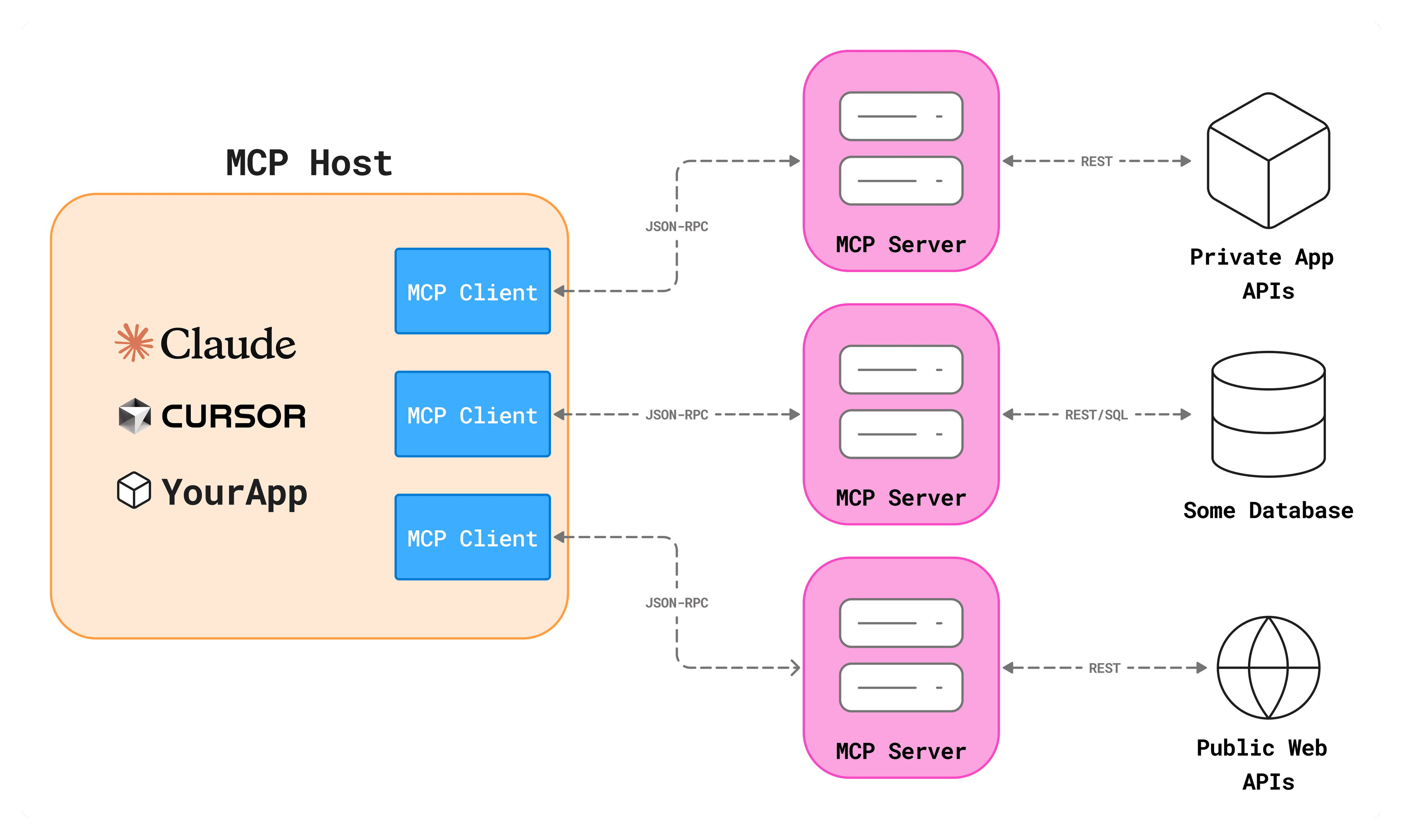
The Model Context Protocol is essentially a standardized way for AI models to interact with external data sources and tools. Think of it as an API layer between your AI and everything else - databases, file systems, web services, you name it.
Instead of hardcoding integrations or writing custom connectors for every single use case, MCP provides a universal protocol. It's like having a standardized power outlet - any device (AI model) can plug in, and any power source (data/tool) can provide energy.
Why Should We Care?
Here's the thing - as developers, we've spent years building APIs, microservices, and integration layers. Now AI comes along, and suddenly we need to build another layer of integrations just for LLMs to access our data.
MCP solves this elegantly:
1. Standardization
No more building custom integrations for every AI service. One MCP server, multiple AI clients.
2. Security
Instead of giving AI direct database access (scary!), MCP acts as a controlled gateway. You define exactly what the AI can and cannot do.
3. Modularity
Want to give your AI access to your MongoDB database? Write an MCP server. Need it to read files? Another MCP server. Want both? Use both servers. Clean separation of concerns.
4. Developer Experience
As someone working with TypeScript and Node.js, building an MCP server is straightforward. It follows patterns we already know - request/response, tools/functions, schema validation.
The Reality Check
Now, let me be honest - MCP is not a silver bullet.
Challenges I see:
- Complexity: For simple use cases, MCP might be overkill. If you're just hitting one API, maybe you don't need a whole protocol.
- Performance: Adding another layer always has overhead. For real-time applications, this matters.
- Learning Curve: It's a new standard, which means new concepts, new debugging, new edge cases.
- Ecosystem Maturity: The tooling and community are still growing. Expect rough edges.
Where I Think MCP Shines
From a practical standpoint, here's where I think MCP really makes sense:
1. Enterprise Applications When you have multiple teams, multiple data sources, and need strong access controls - MCP provides that structure.
2. Complex Integrations If your AI needs to interact with databases, APIs, file systems, and external services - having a standardized protocol prevents integration chaos.
3. Multi-Model Scenarios When you're working with multiple AI models (GPT, Claude, local models), MCP means you write integration code once.
My Experience Building with MCP
I experimented with building a simple MCP server for database operations using TypeScript, and here's what stood out:
The Good:
- TypeScript support is excellent
- The protocol is well-documented
- Error handling is built into the spec
- Tool definitions using schemas (like Zod) feel natural
The Frustrating:
- Debugging MCP calls isn't as straightforward as debugging REST APIs
- Testing requires setting up the full protocol flow
- Not many examples for complex scenarios yet
The Bigger Picture
Here's my hot take: MCP is part of a larger trend - treating AI as a first-class citizen in our architecture.
Just like we moved from monoliths to microservices, from server-side rendering to SPAs, from REST to GraphQL - we're now figuring out the right patterns for AI integration.
MCP is one approach. It might not be the final answer, but it's pushing us in the right direction:
- Standardization over custom solutions
- Security by design
- Separation of concerns
- Protocol-driven development
Should You Learn MCP?
If you're:
- Building AI-powered applications professionally → Yes, absolutely
- Working in a team with multiple AI integrations → Yes
- Curious about AI engineering patterns → Yes
- Just building a simple chatbot → Maybe not yet
The protocol is still evolving, but the concepts are valuable regardless. Understanding how to build controlled, secure AI integrations is a skill that will transfer even if MCP itself changes.
What I'm Watching
Moving forward, here's what I'm keeping an eye on:
- Performance benchmarks - How does MCP overhead compare to direct integrations?
- Tooling evolution - Better debugging, testing, and monitoring tools
- Community adoption - Which frameworks and platforms will have first-class MCP support?
- Real-world patterns - What architectural patterns emerge for complex MCP deployments?
Final Thoughts
MCP Server represents a thoughtful approach to a real problem. As developers, we need better ways to integrate AI with our existing systems safely and efficiently.
Is it perfect? No. Is it promising? Absolutely. Should you ignore it? Definitely not.
The AI integration space is moving fast, and having a standardized protocol like MCP in your toolkit - even if you don't use it immediately - makes you a more versatile developer.
For me, as someone building with the MERN stack and exploring AI integrations, MCP gives me a structured way to think about these problems. It's not just about the code - it's about the architecture, the patterns, and the mindset of building AI-aware applications.
What's your take on MCP? Have you built anything with it? I'd love to hear different perspectives, especially from developers working in production environments.
Building in public, learning in public. That's the only way forward.